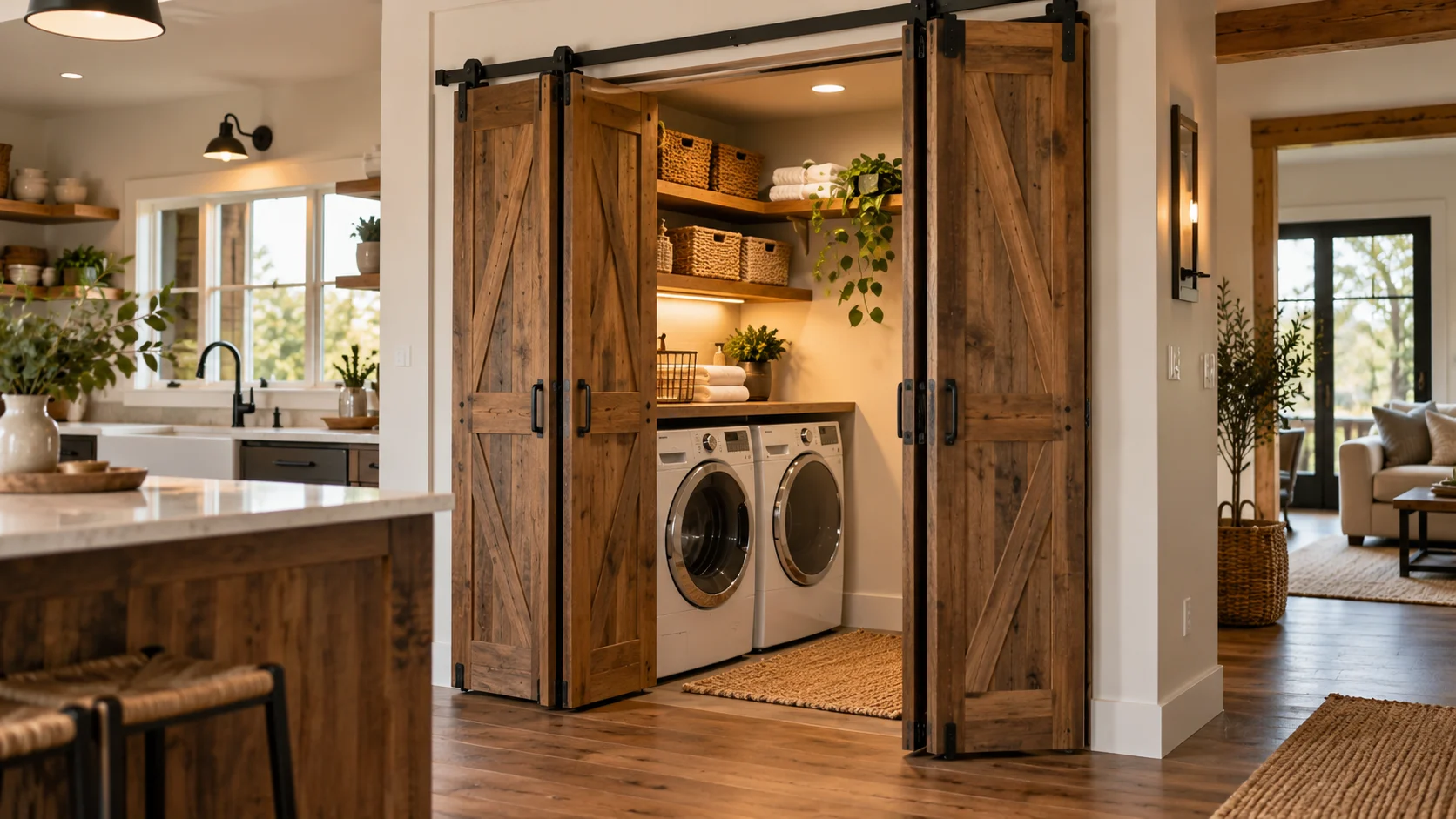
Bifold barn doors are a stylish and practical solution for homeowners who want to save space without sacrificing interior design. These doors combine the rustic appearance of traditional barn doors with a folding mechanism that makes them suitable for smaller rooms and narrow openings. Unlike conventional sliding barn doors, bifold designs use hinged panels that fold together, reducing the amount of wall space needed for opening.
Whether you are renovating a closet, updating a bedroom, or improving a compact living area, bifold barn doors offer numerous decorative and functional possibilities. They are available in different materials, finishes, hardware configurations, and price ranges. This guide explains bifold barn door types, space-saving benefits, installation costs, design ideas, and practical buying tips to help you choose the right doors for your home.
What Are Bifold Barn Doors and How Do They Work?
Bifold barn doors are interior doors made from hinged panels that fold together while moving along a compatible overhead track system. Most designs feature two or more panels connected by hinges, allowing them to fold toward one side or separate into sections. Their distinctive operation combines the appearance of sliding barn doors with the compact movement of traditional bifold doors.
The door panels are supported and guided by specialized hardware that may include tracks, rollers, hinges, pivots, and mounting brackets. When the door opens, the connected panels fold together rather than traveling completely along the adjacent wall. This arrangement reduces the continuous wall clearance required by a conventional sliding barn door.
Bifold barn doors are commonly installed in closets, pantries, laundry rooms, and other interior openings where space is limited. They can also be used for selected bedrooms and bathrooms when privacy requirements are considered. Proper measurements and compatible hardware are essential because the panels must have enough clearance to fold without hitting nearby furniture or walls.
Benefits of Installing Bifold Barn Doors
One of the biggest advantages of bifold barn doors is their space-saving design. Traditional swinging doors require clearance throughout their opening arc, while sliding barn doors need sufficient unobstructed wall space. Bifold barn doors reduce these limitations by allowing panels to fold together, making them useful in compact rooms and narrow hallways.
Another benefit is the variety of available styles, materials, and decorative finishes. Homeowners can choose rustic wooden panels, modern painted doors, glass inserts, or contemporary minimalist designs. This flexibility allows bifold barn doors to complement farmhouse, industrial, traditional, and modern interiors without requiring major changes to existing room layouts.
Bifold barn doors can also provide convenient access to closets, storage areas, and utility spaces. Their folding movement may create a wider usable opening than certain conventional door arrangements. However, the folded panels still occupy some space, so homeowners should evaluate the exact hardware configuration before assuming a particular system will fit.
Bifold Barn Doors vs. Traditional Sliding Barn Doors
Traditional sliding barn doors generally consist of one or more panels that move horizontally along a track mounted above the doorway. To open fully, the panels usually need sufficient clear wall space beside the opening. This can become inconvenient when nearby furniture, electrical outlets, or architectural features limit the available wall area.
Bifold barn doors operate differently because their connected panels fold toward one side or split between both sides. This reduces the amount of continuous wall space required for the door system. However, the folded panels project outward into the room, making furniture clearance another important consideration during installation planning.
Both styles provide an attractive alternative to ordinary hinged doors, but they suit different room conditions. Sliding barn doors may offer simpler movement when adequate wall space is available. Bifold barn doors are particularly useful when lateral clearance is limited, although they involve additional hinges and moving components that require proper adjustment.
Different Types of Bifold Barn Doors
Bifold barn doors are available in several configurations designed for different opening widths and room layouts. Two-panel systems are commonly used for smaller closets and doorways, while four-panel systems can accommodate wider openings. Some configurations fold toward one side, while others separate into two folding sections that move in opposite directions.
Traditional wooden bifold barn doors often feature decorative crossbars, framed panels, or rustic finishes. Contemporary styles may use smooth surfaces, simple vertical lines, or mixed materials. Glass-panel designs are another option for spaces where homeowners want a more open appearance while retaining some separation between rooms.
Door construction also differs between lightweight engineered materials and heavier solid wood panels. The selected hardware must support the combined weight and movement of the panels. Choosing a configuration based on opening size, intended use, and available clearance helps ensure that the finished door operates comfortably and complements the surrounding space.
Wooden Bifold Barn Doors for Rustic Interiors
Wooden bifold barn doors are popular in farmhouse and traditional interior designs because they offer natural textures and distinctive grain patterns. Common materials include pine, oak, and other suitable wood products. Their appearance can range from unfinished rustic boards to carefully painted or stained panels designed to match surrounding furniture.
Natural wood doors provide opportunities for customization through stains, protective finishes, and decorative hardware. Light wood colors can create a warm and inviting atmosphere, while darker finishes may add contrast to neutral walls. Homeowners can also choose panels with simple horizontal or diagonal detailing to achieve a classic barn-inspired appearance.
Wood is sensitive to changing indoor humidity, so appropriate material preparation and finishing are important. Solid wood panels can also be relatively heavy, making hardware weight ratings essential. Buyers should compare construction quality, panel thickness, and manufacturer specifications before selecting wooden bifold barn doors for everyday residential use.
Modern Bifold Barn Doors for Contemporary Homes
Modern bifold barn doors offer a cleaner interpretation of traditional barn door designs through simple lines and understated finishes. Smooth painted panels, narrow frames, and neutral colors can complement contemporary interiors. These doors are particularly attractive in homes where space efficiency and visual simplicity are important design priorities.
White, gray, and matte black are common finish choices for modern bifold barn doors. Some designs incorporate vertical grooves, geometric detailing, or contrasting metal hardware. Matching the door finish with cabinetry, interior trim, or furniture can create a coordinated appearance without making the doorway visually overwhelming.
Modern designs are suitable for home offices, bedroom closets, laundry spaces, and other interior areas. However, appearance should not be the only purchasing consideration because panel construction and hardware quality influence performance. Selecting doors with suitable clearances, durable hinges, and compatible tracks helps maintain smooth movement over time.
Glass Bifold Barn Doors for Brighter Spaces
Glass bifold barn doors are an attractive option for interiors where maintaining natural light is important. These designs typically combine glass panels with wooden or metal frames. They can create visual separation between rooms while allowing light to pass through, making smaller spaces feel more open and connected.
Frosted or textured glass may provide additional visual privacy compared with clear panels. However, the level of privacy depends on the specific glass design, lighting conditions, and surrounding environment. Homeowners should assess whether the chosen product provides enough coverage for bedrooms, bathrooms, or other spaces requiring greater separation.
Glass doors require compatible safety glazing and hardware capable of supporting their weight. Installation requirements may differ from those of lightweight wooden panels. Choosing products designed specifically for residential door applications helps ensure that the glass, frame, and folding mechanism function together as an approved system.
Bifold Barn Door Ideas for Small Closets
Small closets are among the most practical locations for bifold barn doors because limited room space can make traditional swinging doors inconvenient. Folding panels allow access to stored clothing and personal belongings without requiring a large door-swing area. The compact design can also help maintain clear pathways in bedrooms and narrow dressing spaces.
For a modern closet, simple white panels with understated hardware create a clean appearance. Rustic wooden doors may complement farmhouse bedrooms, while darker finishes can introduce visual contrast. Selecting handles that are easy to grip and positioned appropriately helps make the closet convenient to use during everyday activities.
Homeowners should measure the closet opening carefully because the folded door panels still occupy part of the accessible space. Shelf placement and nearby furniture can affect how comfortably the doors operate. Choosing a suitable panel configuration helps balance storage access, appearance, and the available floor area.
Bifold Barn Doors for Bedrooms
Bifold barn doors can provide an interesting design feature in bedrooms, particularly when used for closets or adjoining dressing areas. Their folding movement may reduce the space required by conventional hinged doors. Homeowners can coordinate the door style with bedroom flooring, furniture, and wall colors to create a consistent interior appearance.
Wooden panels with natural finishes work well in cozy bedrooms, while smooth painted doors complement minimalist spaces. Decorative black tracks and handles can provide an industrial-inspired touch. For smaller bedrooms, lighter colors may help create a brighter appearance without adding excessive visual weight to the room.
When using bifold barn doors as room entrances, privacy and sound transmission deserve careful attention. Many barn-style systems have visible perimeter gaps and do not seal as tightly as conventional doors. Homeowners who prioritize acoustic privacy should evaluate specialized products or consider whether a traditional door provides better performance.
Bifold Barn Door Ideas for Bathrooms
Bifold barn doors can be attractive for certain bathroom entrances when available space makes a conventional swinging door difficult to accommodate. Folding panels may reduce interference with nearby fixtures or hallways. However, the design must provide adequate privacy, reliable operation, and suitable clearance for people entering and leaving the room.
Painted wooden doors, moisture-resistant engineered panels, and appropriate finishes are common options for bathroom environments. Frosted glass can create a decorative appearance, although transparency and gaps should be considered carefully. Locking hardware must also be compatible with the folding mechanism and appropriate for the intended privacy requirements.
Bathrooms with higher humidity require materials and hardware designed for changing moisture conditions. Homeowners should also consider accessibility, ventilation, and emergency access before selecting a door system. Not every bifold barn door kit is suitable for bathroom use, so manufacturer specifications and local building requirements should guide the final decision.
Bifold Barn Doors for Laundry Rooms and Pantries
Laundry rooms and pantries are practical locations for bifold barn doors because they frequently contain storage areas near busy household pathways. Conventional swinging doors can interfere with appliances, cabinets, or nearby furniture. Folding doors provide an alternative that may reduce these conflicts while maintaining an attractive finished appearance.
In laundry rooms, simple painted panels can complement cabinets and shelving while concealing appliances when the doors are closed. Pantry doors may feature rustic wood finishes or decorative designs that coordinate with kitchen cabinetry. Homeowners can also choose matching hardware finishes to create continuity between nearby rooms.
These applications require careful measurement because appliances and storage shelves must remain accessible when the doors are fully open. Folded panels may project into the surrounding area and partially obstruct the opening. Evaluating appliance clearance, ventilation needs, and daily usage helps ensure the door design remains practical rather than purely decorative.
How Much Do Bifold Barn Doors Cost in 2026?
Bifold barn door costs vary according to panel materials, size, hardware quality, and installation complexity. In the United States, basic door and hardware combinations may cost approximately $200 to $700. Premium wooden panels, custom finishes, and specialized folding mechanisms can increase material expenses substantially, particularly for larger openings.
Professional installation adds labor costs that depend on wall conditions, hardware configuration, and the amount of preparation required. Straightforward projects may involve several hundred dollars in labor, while complicated installations cost more. A standard professionally installed bifold barn door project may reasonably require a planning budget of approximately $500 to $1,500 or more.
Custom doors, structural reinforcement, wall repairs, and decorative upgrades can raise total expenses beyond basic estimates. Some complex barn door projects reach several thousand dollars. Homeowners should request detailed local quotations and confirm that door panels, folding hardware, mounting supports, finishing, and labor are included before comparing prices.
Factors That Affect Bifold Barn Door Installation Costs
Door dimensions are among the most important factors influencing the final project price. Wider openings may require additional panels, longer tracks, stronger support systems, and more installation time. Custom heights or unusual doorway dimensions can also increase material costs because standard manufactured products may not fit.
Material selection influences both the cost of the door and the strength of the required hardware. Lightweight engineered panels are often more affordable than solid hardwood or decorative glass alternatives. Premium hinges, soft-close components, and specialized mounting systems may add to the budget but can provide useful functionality.
Wall conditions can also affect installation expenses because the track must be securely attached to suitable structural support. Existing trim, uneven walls, and concealed utilities may complicate mounting arrangements. Projects requiring reinforcement, electrical relocation, or finish repairs generally cost more than straightforward installations on adequately prepared walls.
Bifold Barn Door Hardware and Track Systems
Bifold barn door hardware typically includes an overhead track, roller carriers, pivot components, hinges, mounting brackets, and suitable fasteners. These parts work together to support the panels and control their folding movement. Some systems also include floor guides or stops that help maintain alignment and limit unwanted movement.
Track length and hardware configuration depend on the total panel width and the manufacturer’s design. Unlike ordinary sliding barn door systems, bifold hardware must accommodate both horizontal travel and the rotation of connected panels. Choosing components designed specifically for bifold operation is essential because standard sliding hardware may not provide the required functionality.
Premium hardware systems may offer smoother movement, adjustable components, or integrated soft-close features. However, extra features are useful only when they are compatible with the intended door weight and dimensions. Buyers should review complete hardware specifications instead of assuming that any decorative barn door track can support folding panels.
How to Measure for Bifold Barn Doors
Accurate measurements are essential for selecting bifold barn doors that fit the opening and operate without interference. Homeowners should record the doorway width and height at several points to identify variations. Nearby trim, baseboards, lighting, and furniture should also be considered because these elements may affect panel movement.
The total panel width often needs to exceed the opening width to provide appropriate coverage, depending on the hardware system. However, measurement formulas differ between manufacturers and configurations. Ceiling clearance, track position, and folding depth should be determined using the instructions supplied with the selected hardware kit.
Folded panels require room clearance even though they use less continuous wall space than traditional sliding barn doors. Measuring this projection is particularly important near wardrobes, sinks, and other fixed furnishings. Professional measurement can be helpful for unusual openings or installations where limited space leaves little room for adjustments.
Bifold Barn Door Installation: What to Expect
Professional bifold barn door installation generally begins with confirming doorway measurements, structural support, and hardware compatibility. The installer evaluates the mounting surface and determines whether additional backing or reinforcement is required. Proper planning is important because the overhead track must support the panels while allowing their hinges and pivots to operate correctly.
The installation process usually involves securing the track, assembling compatible door hardware, and hanging the connected panels according to the manufacturer’s system. Final adjustments help align the doors and maintain appropriate clearances. Because heavy panels can be difficult to handle, installation should be performed by qualified professionals using appropriate lifting and safety procedures.
After installation, the door should fold smoothly without scraping floors, striking nearby objects, or becoming unstable. The installer should inspect mounting components and verify that the stops and guides function correctly. Homeowners should also receive maintenance instructions and understand how the hardware can be adjusted or serviced if problems develop.
Common Bifold Barn Door Problems and Solutions
Bifold barn doors may develop operational problems when hinges loosen, tracks shift, or rollers become worn. Common symptoms include sticking, uneven panel alignment, scraping, and excessive operating noise. Identifying the underlying cause is important because adjusting one component may not resolve problems involving the overall mounting system.
Door panels that fail to fold properly may have incorrect clearances or incompatible hinge positioning. Loose mounting components can also affect stability and create additional stress on the track. A qualified installer can inspect the system and determine whether adjustment, replacement hardware, or structural correction is necessary.
Unusual sounds and resistance should not be ignored because they can indicate developing mechanical problems. Regular inspections may help identify minor wear before it affects other components. Using manufacturer-approved replacement parts and maintaining proper alignment helps preserve the smooth operation and useful life of bifold barn doors.
Maintenance Tips for Bifold Barn Doors
Regular maintenance helps bifold barn doors remain attractive and operate smoothly over time. Homeowners should inspect accessible hinges, handles, and tracks for visible wear or loose components. Dust and debris should be removed according to the hardware manufacturer’s recommendations to prevent unnecessary interference with moving parts.
Wooden panels may require cleaning with appropriate products that preserve their protective finishes. Painted doors should be maintained using cleaning methods recommended for their specific coatings. Avoiding excessive moisture exposure and harsh chemicals can help reduce finish damage, especially when doors are installed near kitchens, bathrooms, or laundry spaces.
Hardware lubrication requirements vary because some roller assemblies use sealed bearings that do not require additional treatment. Applying unsuitable products can attract dust or damage certain materials. Following the manufacturer’s maintenance schedule and arranging professional repairs when necessary helps support reliable operation without creating avoidable problems.
Common Mistakes to Avoid When Buying Bifold Barn Doors
One common mistake is purchasing doors based only on the width of the opening without considering folding clearance. The panels need space to rotate and stack when opened. Ignoring nearby furniture, trim, or walls can result in doors that fit the opening but cannot operate comfortably.
Another mistake is choosing hardware with an insufficient weight rating for the selected panels. Solid wood and glass doors can be substantially heavier than lightweight engineered alternatives. Using incompatible or underrated hardware may cause premature wear, unstable movement, or mounting problems that require expensive corrections.
Homeowners should also avoid assuming that every bifold barn door provides adequate soundproofing or bathroom privacy. Perimeter gaps and folding joints can allow sound and light to pass through. Evaluating actual room requirements, manufacturer specifications, and installation conditions helps prevent disappointment and ensures the selected system meets practical expectations.
Are Bifold Barn Doors Worth the Investment?
Bifold barn doors can be a worthwhile investment for homeowners who need an attractive door solution where wall and floor space are limited. Their folding mechanism offers flexibility for closets, pantries, and laundry rooms. A suitable design can also contribute to a coordinated interior appearance while improving everyday access to storage areas.
However, the overall value depends on material quality, installation requirements, available clearance, and how frequently the doors will be used. Additional hinges and moving parts can create more maintenance considerations than some simpler door systems. Privacy limitations may also make conventional hinged doors more suitable for certain rooms.
Before purchasing, homeowners should compare bifold barn doors with pocket doors, standard bifold doors, and traditional sliding systems. Each alternative provides different advantages regarding cost, space requirements, and functionality. Selecting the design that best matches the property’s practical needs is generally more important than following a particular interior design trend.
Conclusion
Bifold barn doors combine decorative appeal with a practical folding mechanism that can reduce the wall space required by traditional sliding barn doors. They are available in rustic wood, modern painted finishes, and glass-panel designs suited to different interior styles. Their versatility makes them attractive for closets, pantries, laundry rooms, and selected residential entrances.
Project costs vary depending on door materials, opening dimensions, hardware quality, and installation complexity. Proper measurements and compatible track systems are essential for smooth operation and long-term performance. Homeowners should also consider privacy, maintenance, and the space occupied by folded panels before choosing a particular configuration.
The best bifold barn door is one that balances appearance, functionality, and reliable construction. Quality hardware and appropriate professional installation help create a dependable system that complements the surrounding room. With thoughtful selection and regular maintenance, bifold barn doors can provide an attractive space-saving solution for modern and traditional homes.
Frequently Asked Questions (FAQs)
1. Are Bifold Barn Doors Good for Small Spaces?
Yes, bifold barn doors can work well in small spaces because their panels fold together instead of sliding completely along a wall. However, enough clearance is still needed for the folded panels.
2. How Much Do Bifold Barn Doors Cost?
Basic bifold barn door and hardware combinations may cost approximately $200 to $700. Professional installation and premium materials can increase the total project cost to $500–$1,500 or considerably more.
3. Can Bifold Barn Doors Be Used for Bathrooms?
Yes, some bifold barn doors can be installed in bathrooms, but privacy and moisture resistance require careful consideration. Choose suitable locking hardware and confirm that the door provides adequate coverage.
4. Do Bifold Barn Doors Need a Track?
Yes, most bifold barn door systems use an overhead track with compatible rollers, hinges, and pivots. The track guides panel movement while allowing the connected door sections to fold.
5. Are Bifold Barn Doors Better Than Sliding Barn Doors?
Bifold barn doors require less continuous wall clearance, making them useful near corners and furniture. Traditional sliding barn doors may offer simpler operation when sufficient unobstructed wall space is available.